
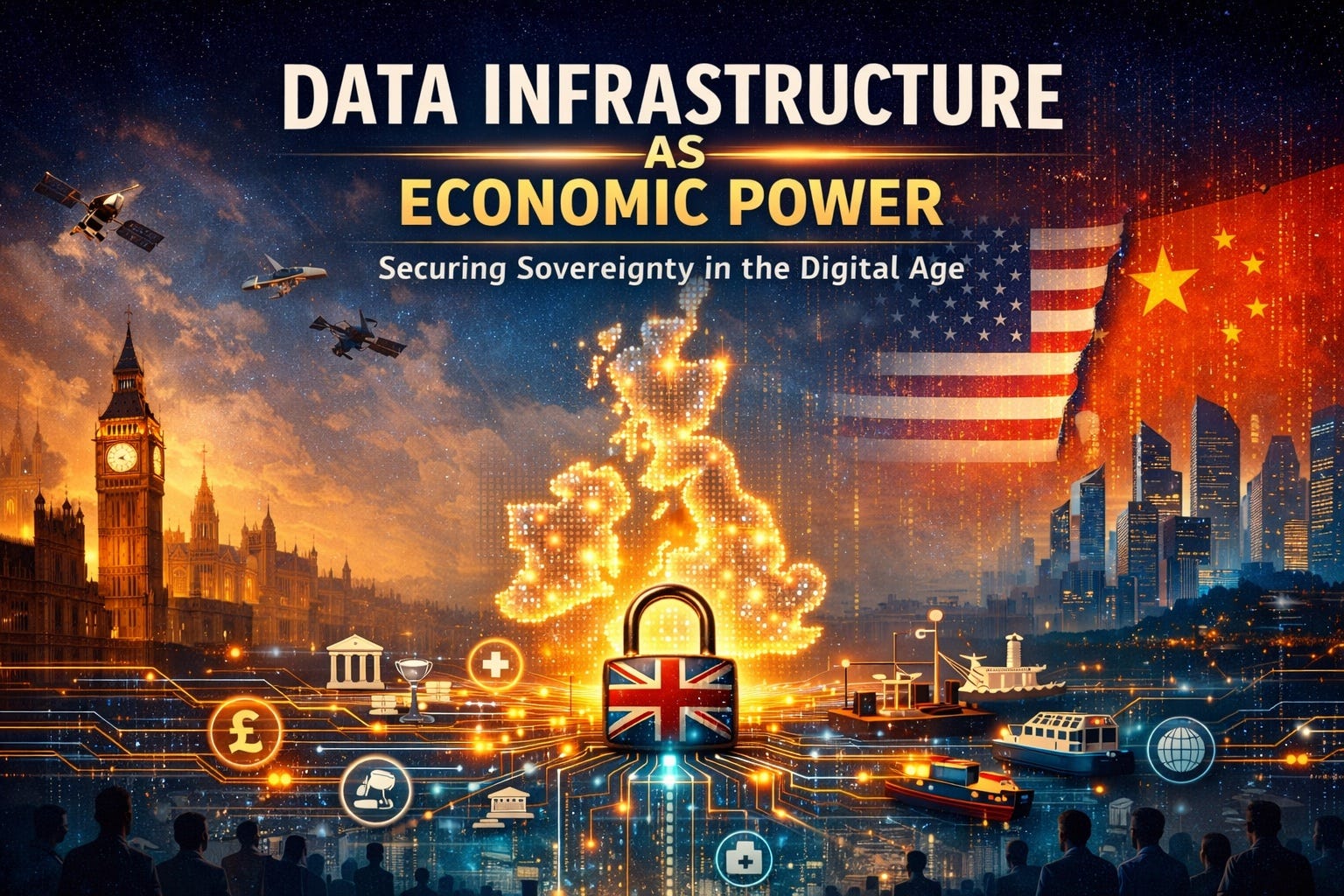
Those who set the rules and govern data flows, control the value
Data infrastructure is not a technical concern nor a subset of digital policy.
It is a core determinant of national power. It shapes how a country governs itself, secures its citizens and its businesses, how it shapes and grows its economy, and how it positions itself in an increasingly hostile geopolitical and commercial landscape. Data infrastructure also increasingly moderates the perceived legitimacy of relationships between government, institutions, business, and the general population.
As data mediates finance, energy, health, transport, housing and public services, the ability to govern how data flows, who controls it, through what processes and on what terms, is now inseparable from national interest.
Without sovereign control of the rules, permissions and layers of trust that determine data access, use and re-use, the UK risks outsourcing core economic and civic functions to foreign platforms, to standards outside of its control and incentives outside its jurisdiction.
This is not just a question of efficiency or cost: it is a question of agency. Who sets the rules of the digital economy? Who captures the value? Whose values and what incentives are encoded into the systems that increasingly shape everyday life and trade?
Addressing these questions can help to shine light on where important centers of power and decision-making capacity lie across the economy, and stimulate debate about what incentives, risks and benefits may exist. These should be considered on a short, medium and long-term commercial and geopolitical basis. They also highlight that a modern data economy requires a secure, trusted and domestically accountable, legally enforceable layer for organisations who use and control data. This is not just technical plumbing but foundational to democratic legitimacy and social trust.
At the same time, the opportunity is substantial. Countries that invest in trusted, interoperable, market-enabling data infrastructures are laying the foundations for a new wave of productivity and growth. The UK’s experience with Open Banking showed what is possible: clear rules, shared standards and strong governance unlocked a multibillion-pound fintech ecosystem used by millions, and positioned the UK as a global exemplar. As it extends this approach with primary legislation across energy, property, health, transport and other sectors it can unlock new markets, attract investment, and reduce friction across the economy.
Countries that can verify business identities while managing consumer permissions and protecting citizen rights in the digital sphere are better equipped to counter fraud, organised crime and interference from hostile actors. Those that can’t expose themselves to systemic risk.
In an adversarial geopolitical environment, data assets such as energy telemetry, financial behaviours and mobility patterns are strategic resources. We must proceed by assuming all digital systems are under continuous both commercial and ‘bad actor’ attack. Resilience depends on open markets, transparency, interoperability, assurance and governance, not just ‘technology infrastructure’ at scale.
This opportunity is also threatened by corporate capture. A small number of (predominantly US-based or Chinese) technology firms increasingly control critical digital infrastructure: cloud, identity, payments, AI models, developer ecosystems and now the data layer itself (data is a different category to technology).
Through proprietary or ‘high friction’ standards, high switching costs and vertically integrated platforms, these firms are de-facto rule-makers. They shape access, pricing and innovation trajectories without public accountability. This concentrates economic power, weakens regulatory leverage and displaces public value with private extraction. Such challenges have been well documented for some time (see selected references).
This is not inevitable and the UK has a credible alternative path. It can use its legal institutions, regulatory sophistication, academic depth and civil-society capability to lead a different model, based on open standards, open source and open governance. Open source in this context is not an ideology but a strategic instrument that underpins the principles of a free market economy. Properly governed, it reduces dependency, improves transparency, lowers barriers to entry, cost and friction, and allows domestic firms to build on shared foundations rather than renting infrastructure from abroad.
Crucially, open governance preserves cultural and democratic sovereignty. It ensures that the rules of the data economy reflect UK legal norms, social values and public-interest objectives.
Through modular, interoperable trust frameworks, the UK can export not just technology but governance itself, positioning the country as a global leader in trusted data markets. This is how economic value can be created at scale: enabling many firms to innovate on shared infrastructure, rather than entrenching a small number of dominant platforms.
The strategic choice is clear: data infrastructure must be treated not merely as national infrastructure, but as a core component of the economy itself. The UK should act accordingly: owning the rules, investing in open components, institutionalising trust frameworks, and using this architecture to drive growth, resilience and global influence. Nations that do this will shape the rules of the digital age. Those that do not will inherit rules written elsewhere.
Selected references
Khan, L.M. (2017) ‘Amazon’s antitrust paradox’, Yale Law Journal, 126(3), pp. 710–805. https://yalelawjournal.org/note/amazons-antitrust-paradox
Kenney, M. and Zysman, J. (2016) ‘The rise of the platform economy’, Issues in Science and Technology, 32(3), pp. 61–69. https://issues.org/the-rise-of-the-platform-economy
OECD (2019) Competition policy in the digital age. https://oecd.org/competition/competition-policy-in-the-digital-age.htm
OECD (2022) The evolving concept of market power in the digital economy. https://oecd.org/daf/competition/the-evolving-concept-of-market-power-in-the-digital-economy.htm
Srnicek, N. (2017) Platform capitalism. https://politybooks.com/bookdetail?book_slug=platform-capitalism–9781509504862
Zuboff, S. (2019) The age of surveillance capitalism: The fight for a human future at the new frontier of power. New York: PublicAffairs. https://publicaffairsbooks.com/titles/shoshana-zuboff/the-age-of-surveillance-capitalism/9781610395694/
Fetter J., Rao, K., Eaves, D. (2025) State of Digital Public Infrastructure Report https://www.ucl.ac.uk/bartlett/publications/2025/nov/2025-state-digital-public-infrastructure-report