Turning your Spotify playlist into a record collection, and why that could be really disruptive
Quick summary
I’ve long wanted to make it easy to buy the music of artists I like, not least because they get better £pay on physical, but when (not if) online services de-list things and hard drives break, they don’t vanish forever.
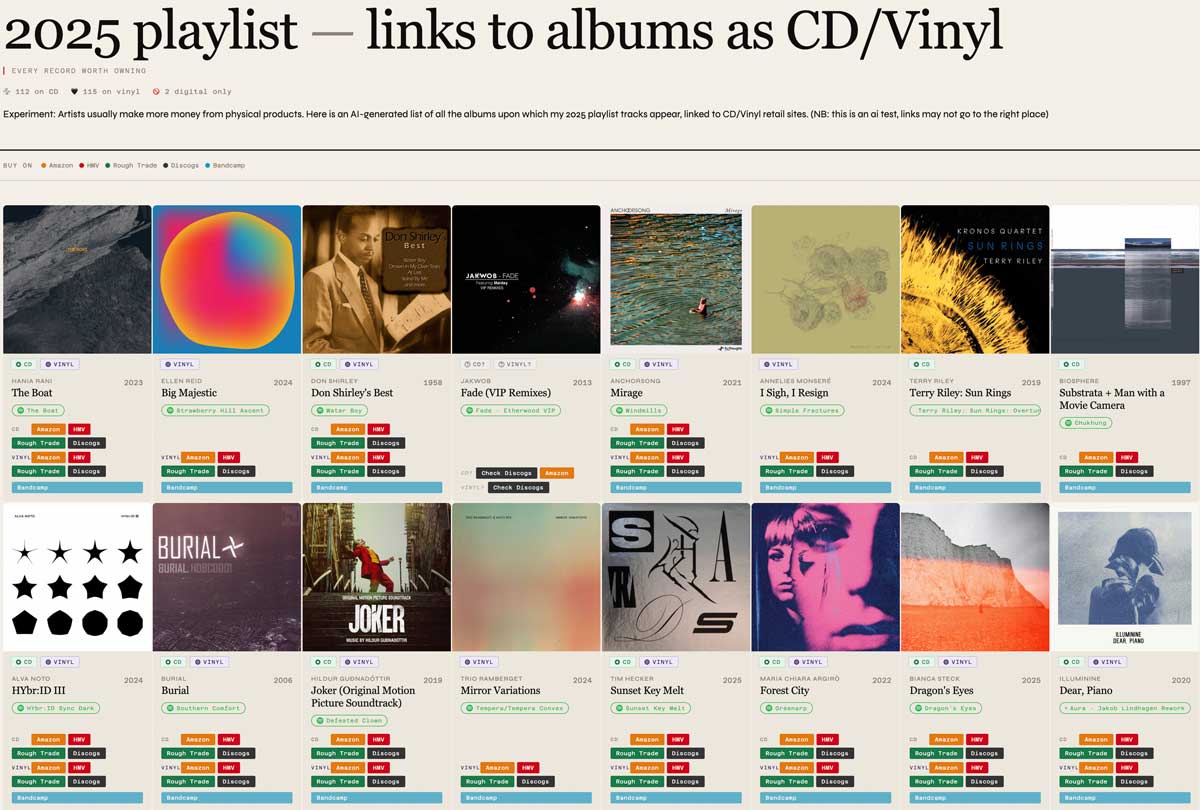
So, here’s a first experiment: pulling out one of my annual playlists into a ‘catalogue/shop window’ that links to various retailers, CD and Vinyl, and Bandcamp if that exists for the artist.
This is only 2025 for now, while I work out some of the bugs. https://dgen.net/w/playlists/2025.html
Update: now live at https://secondpress.club/p/5lx398
Some reflections (over the past three decades)
This is an example of shifting power dynamics in consumption, engagement and how we can help deliver open markets that work for everyone. I’ve also noticed that the music sector is often an early adopter/trailblazer for broader societal shifts.
Music streaming has solved discovery: a near-infinite library at your fingertips, finding new artists, forgotten classics and new connections has never been easier.
However, there’s an issue buried in that convenience: you don’t really ‘have’ any of it. If a label dispute pulls an album, or you cancel your subscription, your carefully curated listening history evaporates. This can also apply to your ‘downloads’ (even with good hard drives and cloud services, we still lose our digital stuff).
I’ve long thought about what it actually means to have a music collection. Back in the day (1998!) I put Virgin Megastores online: all 60,000 products (which is how may CDs were in a typical store), and designed a service with a colleague, Rick Glanville, where we could sell a subscription to digital downloads and give away a tiny MP3 player as part of the package. We even got Cambridge Electronics to make a little postage-stamp sized player. [yes, these pre-dated the iPod, iPod Shuffle and Spotify by many, many years].
While on that journey it struck me that we were in the process of reducing ‘music’ to a search box, killing most of the actual experience outside of listening, destroying record stores, and as humans we were likely to eventually push back on something so techno-reductionist.
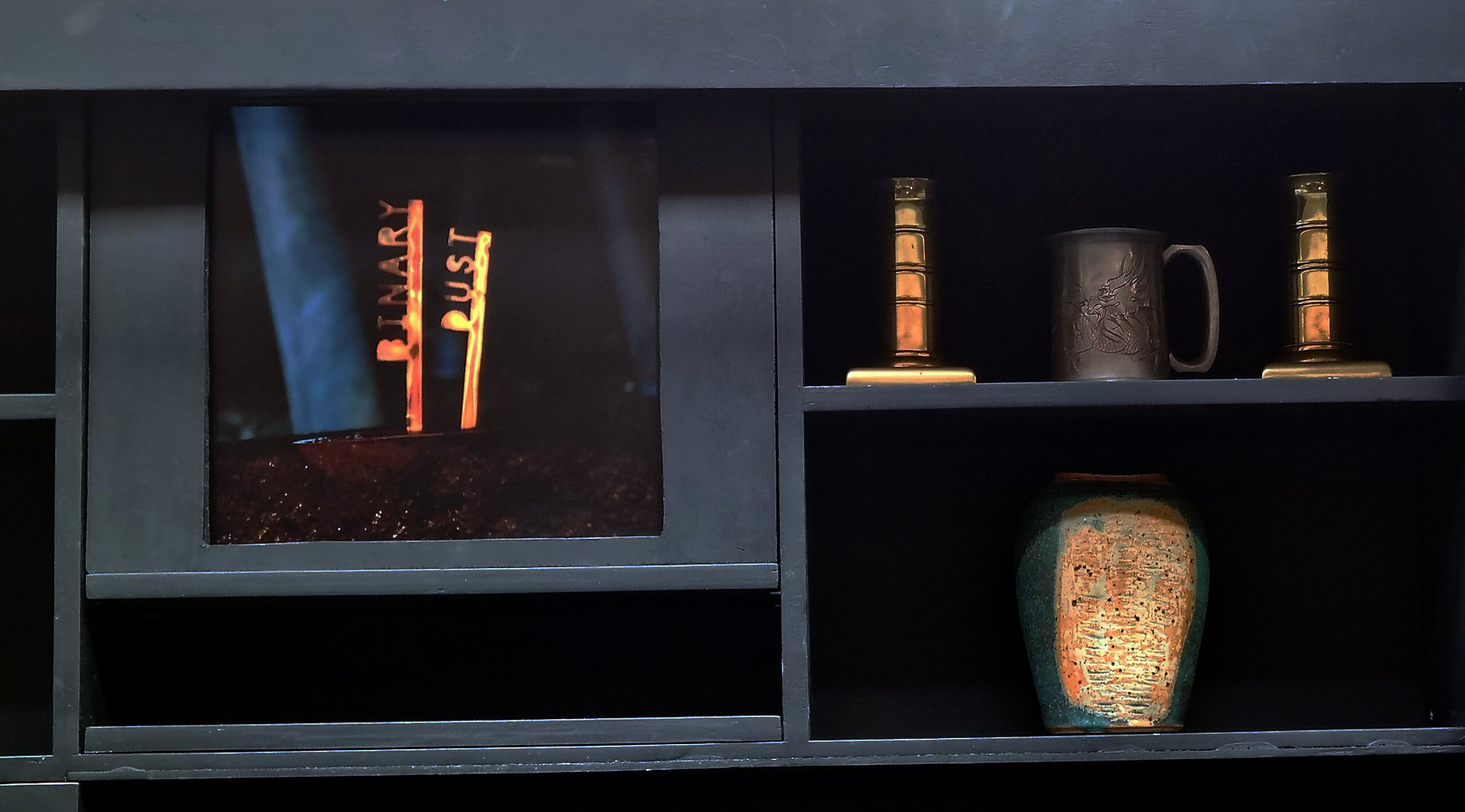
Many of the things we enjoy about music listening are physical: this has played out in the long-term success of stores like Rough Trade, and the resurgence of vinyl (even cassettes are back!). At the time, as a bit of rebellion, I also released my own music as a 19kg solid granite MP3 player and radio transmitter.
In one of my many roles as CEO of Consolidated Independent, we helped get over 20% of the world’s music online: millions of tracks from thousands of labels distributed to hundreds of retailers and services. Some of the labels were terrified of the web destroying their business due to piracy, but the whole system had to embrace it, including sorting out commercial realities. Sadly some of those realities massively skewed market value to ‘the big guys’, including ludicrous statements from some (let’s say ‘commercial’) CEOs that if artists wanted more money they should increase their output (as if art and soup cans are the same thing 😉 ).
Don’t get me wrong, I love the fact we have vast access to new music, and listen to a very diverse range of music. And, it creates different challenges for us as consumers and music fans. Now we can have more agency in balancing out the way the music market works – the cathedrals are not going anywhere, but the bazaar has some new spaces.
What we can now do
One of the things I missed when listening was album art, and a few years back I made a 12″ sized screen to pull down and display whatever I’m playing on Spotify (AI helped me code this, and I would never have got around to it without that help).
Building things just for me is fun, and…
Interestingly, with just a few AI prompts and some lightweight code, I created a tool that takes my Spotify playlist, cross-references every album against Discogs, and produced a personalised catalogue.
Based on the individual tracks I’d added to my annual playlist (which I have going back 8 years now), it looks up the album that it was on. It then works out which are available on CD and Vinyl (or digital–only), where to find them, and who sells them. And, not ‘just Amazon’, but others: Rough Trade, HMV and directly linking back to the artist’s Bandcamp. This is just the start of and idea, and took less than half a day to create it as a prototype.
This makes me wonder about a quiet promise of AI that doesn’t get talked about so much: enabling each of us to build the world we’d like. This will disrupt the big platforms (Spotify, Amazon, Apple) who have invested billions in making their aggregated experience frictionless and hard to leave. They’re using AI to make them more personalised and ‘sticky’. We can do the same for ourselves.
The same AI tools they’re racing to build are equally available to you and me. We can now spin up personalised services—in an afternoon—that would have taken a dedicated development team a decade ago.
So, this is a prototype of a custom, personalised catalogue and record-buying assistant that can be built around your taste, routing money to your preferred retailers that you can share with your friends. It is a small but real act of reclaiming your relationship with artists, and their music, from the big platforms.
We can help bridge the gaps and connect the smaller services together (back to the original vision of the web).
And, looking forward, we can start blending, sharing, cross-connecting using federated services like Mastodon and then connecting people, places, gigs, merch, in a way that could actually help everyone.
Isn’t that exciting!?