
A self-hosted social posting tool, ensuring you own your own content
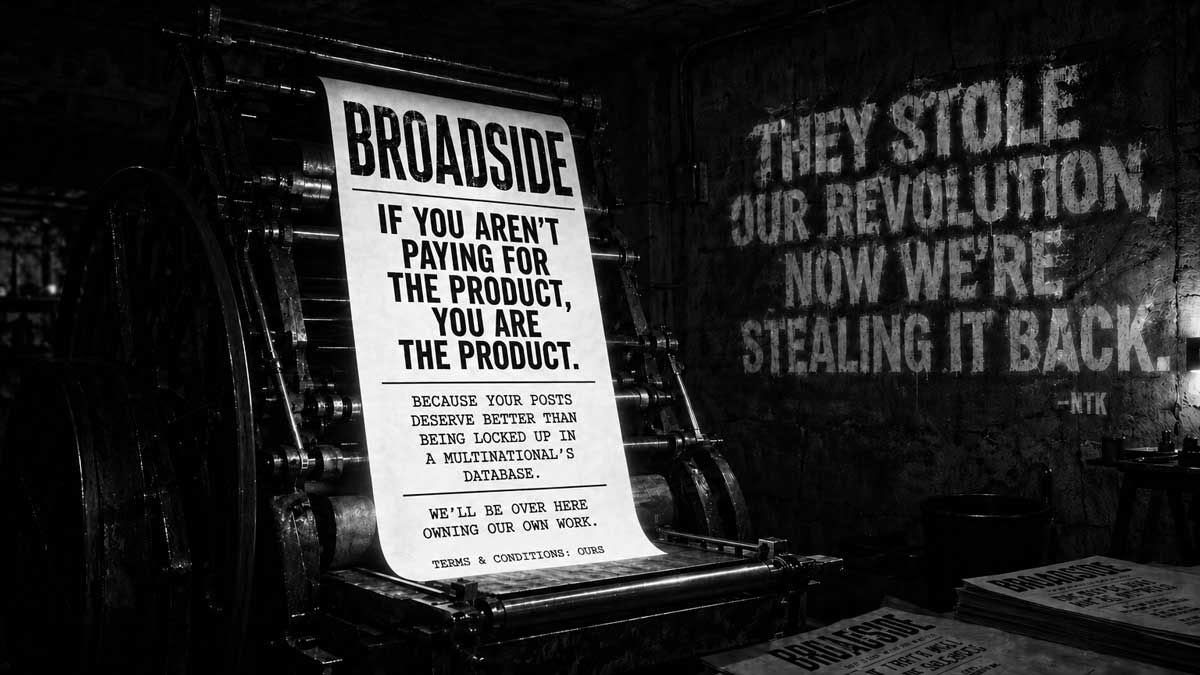
In my ongoing experiments with ai-assisted dev of tools I’d like, I’ve create Broadside to solve a specific irritation. As we all know, “If you aren’t paying for the product, you are the product.” and as all these tools develop their own special enshittifications, it feels like it’s time to have another go at inverting the models.
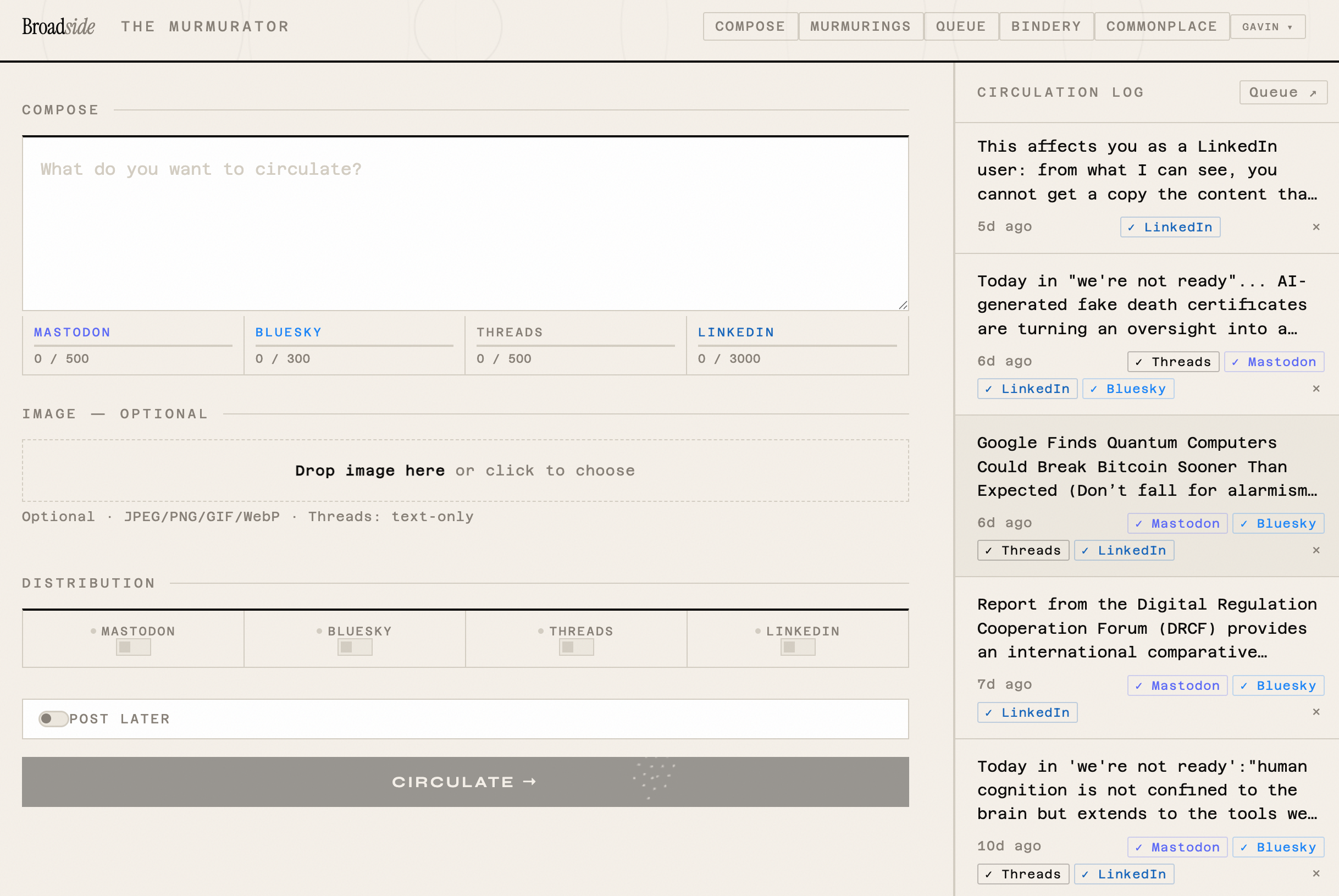
Also, with the demise of that old-bird-site, things have become more federated and fragmented. I wanted to post across Mastodon, Bluesky, Threads and LinkedIn at the same time, and do so without ‘losing’ what I’d written the moment I hit publish.
Broadside it a small web app that posts to all four simultaneously, keeps a searchable archive of everything locally, and pulls social feeds into one place, including creating useful open things, like an RSS feed. This post is about why I made it, what it does, and the slightly eccentric vocabulary it uses.
You can read all my posts here: https://broadside.dgen.net/bindery/gavin
If you’d like to try it, just ping me (on any channel).
You probably didn’t know LinkedIn is a one-way street
If you post to LinkedIn regularly, you’re building a professional record in a place you cannot back up. They do not let you download your own posts in bulk – the “account data export” doesn’t include posts. You can use their API to POST to the site, but not GET your own content back (without paying).
For the platform most associated with professional credibility where people are documenting their work, sharing hard-won thinking, and announcing things that matter to them, to offer no way to retrieve what you’ve put there is, to be generous, unprofessional.
The same applies across many platforms, to varying degrees and I’ve maintained this website (dgen.net) to be both a business site and a master record of my own works, that I completely control. With music I am addressing a version of this by building a tool to convert my Spotify playlists into a physical record catalogue, because streaming solved discovery but not ‘ownership’. Social media has the same shape: it solved distribution but not possession. Broadside is an attempt to do something about that.
And, yes, of course there are loads of self-publishing tools, but they’re often commercialised into their own SaaS businesses with similar issues of enshittification (looking at you TweetDeck/HootSuite), or too ‘techy’ to actually do yourself. Alternative services, like Mastodon are great but also directly compete with, rather than replace the production flow.
What Broadside does
Broadside runs on my own server (you can host your own too, once I get it on GitHub, open licence of course), and it supports multiple users (so I can enable my constellations and communities to use it for free). It connects social accounts, enables a post to be written in a single compose window, and it posts simultaneously to whichever platforms you select (Mastodon, Bluesky, Threads, LinkedIn, or any combination. Note that Facebook and others don’t allow connections like this). Link previews, image attachments and scheduled posts all work.
It also is keep a copy.
Before anything goes to a social platform, it’s written to an archive on my server. That archive is searchable and downloadable. If any other platform disappears, your posts don’t (nb: if my/your server vanishes, you have backups everywhere else you’ve posted). If you want to find what you said about something three years ago, you can. This useful to me – having a personal, searchable archive of all my public writing is just nice, independently of the cross-posting convenience.
There’s also a feed view, pulling in my Mastodon and Bluesky feeds together into one place (NB: LinkedIn and Threads don’t allow this, and Facebook doesn’t allow anything).
With added AI?
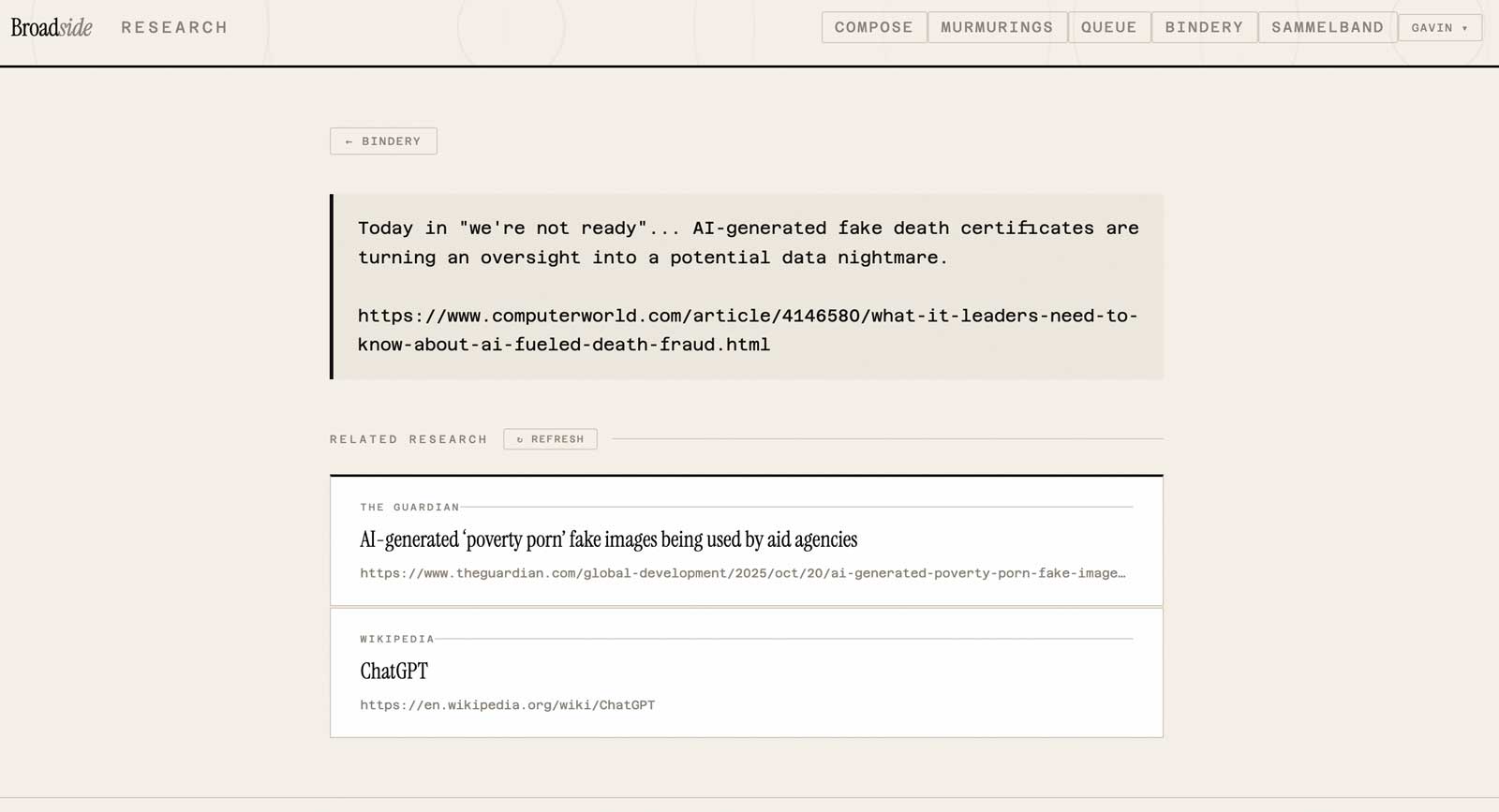
I added an AI-assisted research tool that automatically surfaces related links (e.g. Wikipedia, academic papers, Guardian articles, Hacker News discussions and things I’m experimenting with) for anything I post. This last bit genuinely surprised me with how useful it can be by lowering the ‘friction’ in then googling for references – in an age of fake news, it’s nice to filter on some diverse-yet-trusted sources. The whole thing was built with Claude and, like my other experiments is stuff I wanted but would never have had time to build a decade ago.
And, a white-listed constellation?
Of course, once you’ve got a publishing tool that works well, you can share it with your friends. And then you have something that’s bot-free, curated (h/t haddock), and more akin to the original idea of shared bookmarking and socials. Back to basics, without the tracking (no, really tracking, like LinkedIn scanning all your browser extensions to fingerprint your machine and track you is actually a thing, never mind cookies).
All while not having to switch away from, or shut down, places you like to hangout with other friends and colleagues.
You can probably guess where I might go next with this: not leaving places, but rather connecting them.
On words
Those who know me already know I love finding fun words (e.g. Icebreaker One, AMEE, Tornado) to make using things just feel good. And, of course, design matters deeply to all of this so I’m experimenting with letting people choose their own themes. We love to personalise things.
Note that while I’m using ai for these prototypes, a quick plug for my friends at philpottdesign.com, just because ;).
I’ve given Broadside its own vocabulary because I think it’s more interesting than calling things “dashboard” and “feed”.
Broadside: historically, this is a large sheet printed on one side and distributed as news, proclamations, or verse – one of the original one-to-many formats. It felt right for a tool that takes one piece of writing and to many public spaces at once. Obviously, given my interest in things nautical, broadside is also when all the guns on one side of a warship are fired simultaneously… so quite apt!
The Murmurator: the compose interface. A murmuration is what you see when a flock of starlings moves as one coherent shape. Social media can feel a bit like that and The Murmurator is where you introduce something into the flow.
Murmurings: your own incoming feeds from the people you follow, across the networks.
The Bindery: your personal post archive. The Bindery refers to “a studio, workshop or factory where sheets of (usually) paper are fastened together to make books” [wikipedia] so felt apt for where your own posts are gathered, ordered, and made publicly accessible by default (as a public web page and RSS feed).
Commonplace: As I add people from my constellation into our shared Broadside instance, the Commonplace is our collective archive: everything everyone has posted, in one place (as a public web page and RSS feed). (originally I used Sammelband a German word for a ‘volume that binds together separately published works’ but that was getting a bit too esoteric, even for me).
Addenda: re-establishing control
Stepping aside from all the stupid AI-hype, I think we’re at a fascinating juncture that reminds me of the 1990s early web. The same AI tools that vast platform players are racing to deploy to bind us to them, are equally available to all of us.
We can all now build personalised infrastructure, in hours or days, that would have taken dedicated teams many months or years before. Broadside is an example of this: a small act of reclaiming your relationship with your own writing, from the platforms you publish on and can control.
If we can’t build things for everyone, it won’t work for all of us.
To quote NTK, “THEY STOLE OUR REVOLUTION. NOW WE’RE STEALING IT BACK”